American Rescue Teams Bring Hope After Venezuela Earthquake
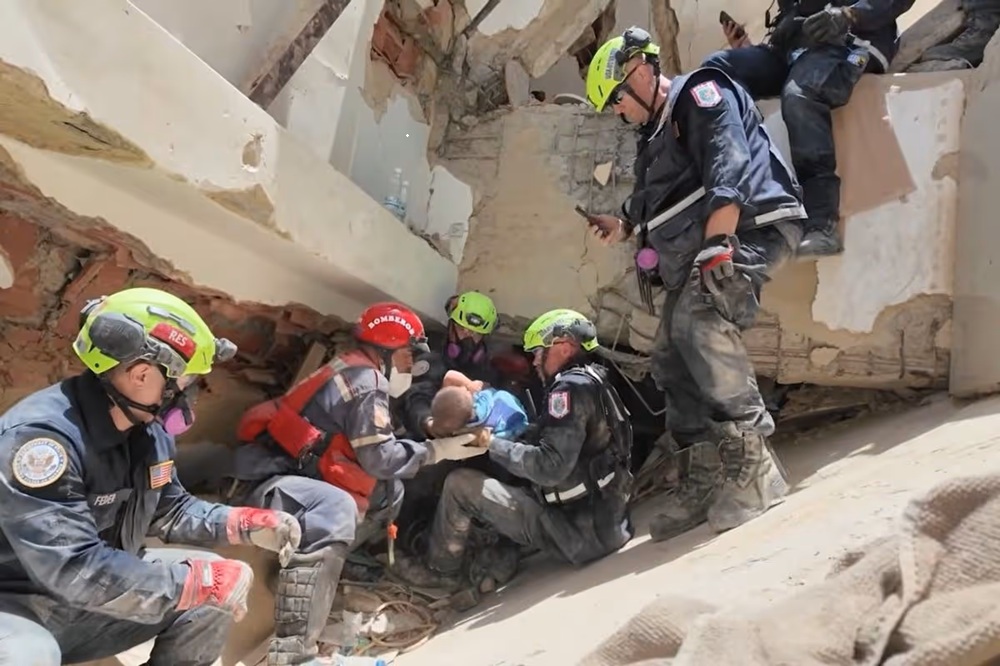
Somewhere beneath the broken concrete and twisted debris of a collapsed building in Venezuela, rescuers heard what every search team hopes for after an earthquake: Signs of life.
Hours had passed. Buildings had fallen. Families were missing. The work was dangerous, slow, and exhausting. But deep inside the rubble, a mother and her nine-month-old baby were still alive.
Members of Virginia Task Force 1, one of America’s elite Urban Search and Rescue teams, carefully worked their way through the unstable debris. Every movement mattered. One wrong cut, one shifted slab, one vibration in the wrong place could turn a rescue into another collapse.
Then came the moment everyone had been working for.
The baby was brought out alive.
In the middle of a disaster zone, surrounded by destruction, the rescue gave the world a rare and powerful image of hope.
American Teams Answer the Call
The dramatic rescue was credited to Virginia Task Force 1, based in Fairfax County, Virginia. But the mission in Venezuela was much larger than a single team or a single moment.
The United States sent multiple Urban Search and Rescue teams to assist after the earthquake, including California Task Force 2, sponsored by the Los Angeles County Fire Department. For Southern California, that gives this international tragedy a local connection.
SCMA Insight: Inside FEMA Search and Rescue Communications
Every FEMA Urban Search and Rescue task force deploys with its own portable communications network, including radio systems, satellite communications, dispatch capabilities, and computer networks. These systems allow rescuers to operate even when local infrastructure has been destroyed.
Read our complete guide: Inside FEMA Urban Search & Rescue Communications
California Task Force 2 is one of the premier disaster rescue teams in the world. Based in earthquake country, the team trains for exactly the kind of nightmare scene seen in Venezuela: collapsed concrete buildings, trapped victims, unstable structures, broken utilities, dust, heat, confusion, and the constant pressure of time.
When these teams deploy, they are not simply “firefighters going overseas.” They are highly specialized rescue units built to operate in the worst conditions imaginable.
The Rescue Team Behind the Headlines
A full Urban Search and Rescue task force is like a small emergency city packed into cargo pallets.
The team may include firefighters, paramedics, physicians, structural engineers, hazardous materials specialists, heavy rigging experts, communications technicians, logistics personnel, canine handlers, and search specialists. Each person has a job. Each job matters.
Search dogs move across debris fields looking for human scent. Technical search specialists lower cameras and listening devices into void spaces. Structural engineers study cracked walls and leaning slabs to decide where rescuers can safely work. Rescue technicians cut, lift, shore, tunnel, and breach their way toward survivors.
This is not fast work. It is careful work.
A rescuer may spend hours moving only a few feet. Crews may have to shore up a wall before they can pass through it, break concrete without collapsing the void below, or lift a slab just enough to reach someone without destabilizing the pile.
That is what makes rescues like the one involving the baby in Venezuela so extraordinary. They are not luck. They are the result of years of training, discipline, teamwork, and nerve.
Training for the Unthinkable
Southern California understands earthquake risk better than most places in the country. That is one reason Los Angeles County’s California Task Force 2 has become so highly regarded.
Team members train for collapsed buildings, confined spaces, trench rescues, rope operations, heavy lifting, disaster medicine, communications failures, and hazardous environments. They practice cutting through concrete, crawling through voids, building wooden shoring systems, and working around unstable structures where aftershocks or shifting debris can change everything in seconds.
The training is physically demanding and mentally intense. Rescuers must be able to work long hours, often in heat, dust, noise, darkness, and emotional stress. They must also be able to slow down when every instinct says to hurry.
In a collapse rescue, speed matters — but precision matters more.
Taking the Rescue Cache With Them
When a team such as California Task Force 2 deploys, it brings a massive cache of equipment.
That equipment can include concrete saws, jackhammers, hydraulic tools, pneumatic lifting bags, ropes, cameras, acoustic listening devices, generators, tents, medical gear, satellite communications, mapping equipment, and supplies to keep the team operating independently.
They also bring something just as important: communications.
For scanner listeners and radio enthusiasts, this is one of the most interesting parts of a major disaster response. When normal infrastructure is damaged or overloaded, rescue teams must create their own communications system. They need to coordinate search teams, medical personnel, logistics, command staff, aircraft, transportation, and sometimes international agencies all operating in chaotic conditions.
Without reliable communications, even the best rescue team becomes far less effective.
Southern California’s Role
California Task Force 2 has deployed to major disasters worldwide and across the United States. Its members have responded to earthquakes, hurricanes, structural collapses, and other major emergencies where local resources were overwhelmed.
The Venezuela deployment is another reminder that Southern California’s emergency services are not only preparing for the next major quake here at home. They are also part of a national and international rescue network that can respond quickly when disasters strike anywhere in the world.
The baby pulled alive from the rubble was rescued by the Virginia team. But the larger story belongs to all of the rescuers who answered the call — Virginia, California, Florida, and others working in dangerous conditions far from home.
They train for years for moments most people hope never come.
And when those moments do come, they go.
Hope Beneath the Rubble
Earthquakes are measured in magnitude, damage, and death tolls. But for rescue teams, the mission is measured one void space at a time, one sound at a time, one survivor at a time.
In Venezuela, amid the broken buildings and grief, American rescuers helped deliver the kind of moment that keeps these teams going.
A baby was found alive.
A mother survived.
And for a few minutes in the middle of disaster, the world saw what training, courage, and determination can do.