A 93 year old water main broke near the campus of UCLA sending a torrent of raging water through parking structures and athletic facilities.
The 30-inch pipe’s rupture shot water 30-feet into the air sending an estimated 20 million gallons roaring onto roads and the campus.
Urban search and rescue crews from the LAFD searched the flooded parking garages for any possible victims. No injuries were reported from the flooding.
LADWP crews have completed shutting off water to the 30-inch trunkline that ruptured earlier this afternoon on Sunset Boulevard, near UCLA.
LADWP deployed their new incident command vehicle. This is the first time it has been used.
Preliminary information indicates that no customers are without water and water quality was not adversely impacted. Crews will begin work immediately to repair the 30-inch ruptured steel-riveted pipe that delivers water to the area at a high velocity from Upper Stone Canyon Reservoir.
Crews shut off three large diameter valves as quickly and safely as they could, taking care to avoid further damage due to pressure in adjacent pipes that could have lead to further ruptures if care was not taken.
Water flow through the pipe was estimated at 75,000 gallons per minute at the peak. LADWP serves approximately 500 million gallons of water to customers each day.
Members of the public are advised to avoid the area.
Recommended traffic detours are as follows: Westbound on Sunset should go south on Beverly Glen then west on Wilshire Boulevard then back north on Veteran/Sepulveda to get around the closure. Eastbound traffic should head south on Veteran/Sepulveda then east on Wilshire Boulevard, then head north on Beverly Glen. For access into UCLA Campus please use Westwood Boulevard.
Parker Center, the iconic headquarters of the Los Angeles Police Department for over half a century, has closed its doors for the last time. Using a chain of handcuffs, LAPD Chief Charlie Beck on Tuesday January 15th locked the doors as several active and retired police officers, some wearing uniforms of years past, looked on….
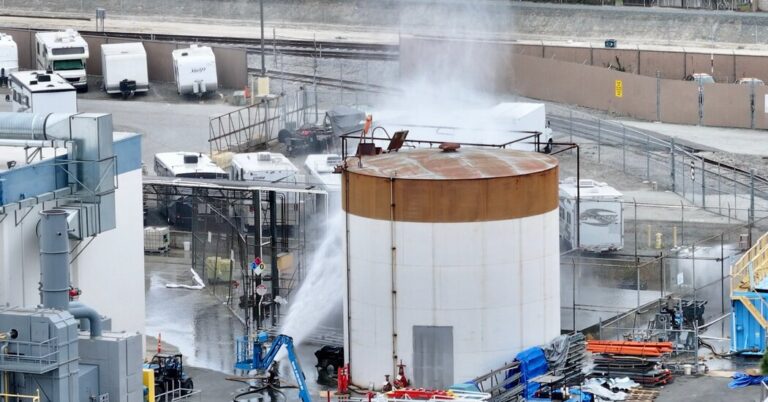
A major hazardous materials incident continues in Garden Grove after a large industrial storage tank containing methyl methacrylate (MMA) entered what fire officials are describing as a potentially catastrophic condition. The incident began Thursday afternoon, May 21, 2026, at the GKN Aerospace facility near Western Avenue and Lampson Avenue in Garden Grove. According to the…
Please join members of your Los Angeles Fire Department this Friday, September 30, 2011 from 11:00 AM to 2:00 PM for the 12th Annual Public Safety Appreciation Barbecue in Downtown Los Angeles. Hosted by the Downtown Los Angeles Center Business Improvement District on the upper level of 7+Fig (soon known as FigAt7th) at 735 South Figueroa Street, this public event honors the men and women of the…
Marines with Marine Attack Squadron (VMA) 214 remove ordnance from an AV-8B Harrier II at Marine Corps Air Station Miramar, Calif., Nov. 29. Marines prepared several Harriers to support Winter Fury 18, which spans several locations including Marine Corps Air Ground Combat Center Twentynine Palms, Marine Corps Base Camp Pendleton, MCAS Miramar and MCAS Yuma,…
The Los Angeles Fire Department deployed its drones for the first time to survey the Skirball Fire near Bel-Air on Dec. 7, 2017. Fire Chief Ralph Terrazas announced the move in a Thursday morning press conference, and by late afternoon two drones had conducted reconnaissance at the north end of Moraga Drive for about 30…
The following letter was posted on the GRE America Web Site: GRE Official Announcement 10/23/2012 October 23, 2012 To our valued Dealers and Customers, Due to circumstances beyond its control, General Research of Electronics of Japan (GRE) is temporarily not able to manufacture the GRECOM and Radio Shack branded radio scanners. The Chinese…
 water through parking structures and athletic facilities.