
Military Training Drills in Pasadena and Irvine Draw Attention Across Southern California
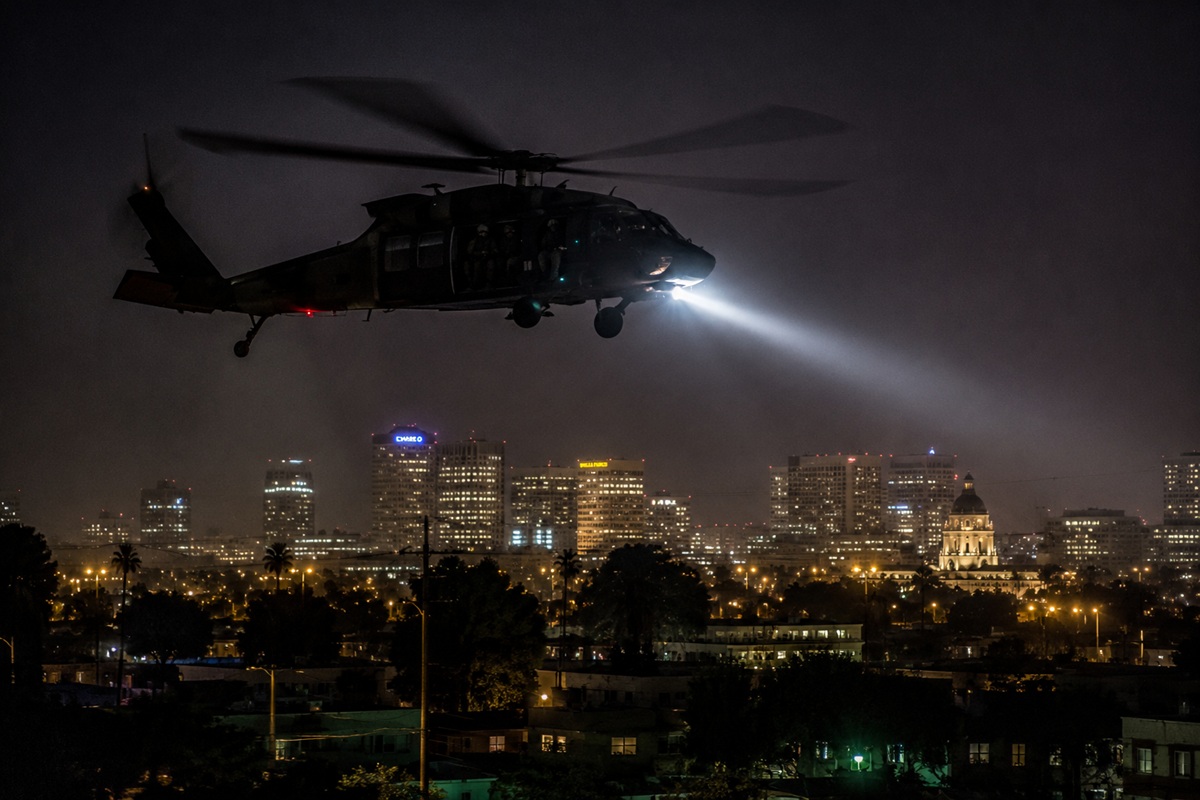
A late-night U.S. military training exercise involving helicopters, simulated weapons fire and controlled explosions startled residents in northeast Pasadena Wednesday night and early Thursday morning, while a separate military exercise involving helicopter activity was also announced in Irvine.
The Pasadena drill took place at the former St. Luke Medical Center property near East Washington Boulevard and Altadena Drive. City officials described it as a standard military training exercise, but the short public notice, loud nighttime activity, and lack of information about the participating military unit prompted questions from residents and local officials.
What happened in Pasadena
Pasadena officials notified the public on Wednesday evening, June 3, that a U.S. military training exercise would take place in northeast Pasadena and could include limited helicopter activity, controlled explosions, and simulated weapons fire. The city said the exercise was expected to continue until about 1:00 a.m. Thursday, June 4.
The activity centered on the former St. Luke Medical Center, a long-vacant hospital campus near Washington Boulevard and Altadena Drive. Published reports and video from the area showed helicopters operating near the building and personnel rappelling onto the roof.
Pasadena Police Department officers assisted with pedestrian and vehicle safety around the immediate area. The exercise was not open to the public or the media.
No public statement reviewed by SCMA identified the military branch, unit or command involved. That remains one of the biggest unanswered questions.
Public notice became part of the story
The city’s public notice went out only a few hours before the activity began. Pasadena Now reported that the city alerted media and residents at about 5:30 p.m. The Los Angeles Times reported that city spokesperson Lisa Derderian said the first round of noise was expected around dusk, about 8:30 p.m., and that Pasadena used social media, Nixle, and Reverse 911 to notify the public.
The late notice drew criticism from Pasadena Councilmember Rick Cole, who said the city was informed the same day and was told not to release information until 5:30 p.m.
Reports differ slightly on when the exercise ended. The city notice said the activity would continue until 1:00 a.m. ColoradoBoulevard.net reported that the operation concluded around 1:45 a.m. CBS Los Angeles reported that activity continued until about 2:00 a.m. Because the military has not issued a detailed public timeline, the exact operational end time has not been independently confirmed.
A related drill in Irvine
Orange County residents also saw notice of military training activity on Wednesday night. Irvine Police Department posted that on June 3, from 8:00 p.m. to midnight, the U.S. military would conduct a training exercise in the area of Alton Parkway and Irvine Boulevard.
The Irvine notice said residents might observe helicopters in the area, but no other training activity would be visible to the public. Irvine police personnel were on site to assist with coordination and safety.
As with Pasadena, no public information reviewed by SCMA identified the military branch, unit, command, or aircraft involved in the Irvine exercise.
Why these drills matter to radio listeners
For scanner listeners and aviation monitors, these exercises are a reminder that some of the most interesting activity in Southern California may not be monitorable in the traditional way.
The public may see helicopters, hear aircraft, or notice increased police activity around a training site, but that does not mean the tactical communications will be available on a scanner. Military operational channels, law enforcement tactical channels, and interagency coordination channels may be encrypted, frequency-hopping, low-power, federal, military, or otherwise outside the reach of normal hobby monitoring.
That said, there are still useful things listeners can watch during similar events.
Aircraft operating through controlled airspace may communicate with civil air traffic control. Depending on the location and route, aviation monitors may hear traffic on nearby tower, approach, departure or airfield frequencies. Aircraft may also appear on ADS-B or Mode-S tracking sites, although military aircraft often do not appear, may use limited data, or may be blocked from some public tracking services.
In the Irvine area, Los Alamitos Army Airfield is a logical aviation monitoring point for regional military helicopter activity, but there is no publicly confirmed information linking this specific exercise to Los Alamitos. Monitors should avoid making that assumption unless it is confirmed by flight tracking, radio traffic, or an official statement.
What listeners may be able to monitor
In future events of this type, listeners may be able to monitor:
- Local fire and EMS dispatch if a public safety response is generated.
- Civil aviation traffic, if participating aircraft communicate with tower, approach, departure, or airport advisory frequencies.
- Public agency information channels, Nixle alerts, official city social media, police department public information posts, and emergency notification systems.
- Aircraft tracking websites such as ADS-B Exchange, FlightAware, or Flightradar24, if aircraft are transmitting usable tracking data.
- For aviation monitoring near Los Alamitos Army Airfield, publicly listed airfield frequencies include Los Alamitos Tower at 123.850 MHz, Ground at 126.950 MHz, ATIS at 118.875 MHz, and SoCal Approach/Departure at 125.350 MHz. Military UHF counterparts are also listed in public aviation references. These are air traffic frequencies, not tactical military channels.
What listeners probably cannot monitor
Listeners should not expect to hear the actual tactical side of a military training exercise. Military teams may use encrypted, secure, or non-public communications. Even when aircraft are audible on civil air traffic channels, those transmissions may only reveal routine routing, altitude, or airspace coordination.
Pasadena police communications are also limited for public monitoring. Pasadena has long used the ICIS/ICI regional trunked system, and Pasadena police operations have been reported to be encrypted, except for limited public or media dispatch access. Any perimeter, tactical, or sensitive law enforcement coordination related to a military exercise would likely not be available to the general public.
In Orange County, public safety communications are carried on the countywide 800 MHz Countywide Coordinated Communications System. Law enforcement monitoring in Orange County is heavily restricted by encryption, while some fire and public safety traffic may still be monitorable depending on agency and talkgroup. During a military exercise, any law enforcement or tactical coordination should be assumed unavailable unless confirmed otherwise.
Southern California context
Southern California has a long history of military aviation, reserve component activity, urban training, special-event security planning, and joint public-safety coordination. The region includes major military installations, dense airspace, large ports, federal facilities, high-profile event venues, and a complicated mix of local, county, state, and federal agencies.
That is exactly why these drills attract attention from the monitoring community. A helicopter over Pasadena or Irvine is not just a noise complaint for radio listeners. It raises practical questions: What aircraft were involved? Were they talking to civil ATC? Did they stage from a local airfield? Were public safety agencies coordinating on local systems? Did any of the activity show up on ADS-B? Were notices sent early enough for residents and monitors to understand what they were seeing and hearing?
At this point, only some of those questions can be answered.
What still needs confirmation
The military branch, unit, or command involved has not been publicly confirmed.
The type and number of aircraft used have not been officially identified.
The full training objective has not been released.
The relationship, if any, between the Pasadena and Irvine exercises has not been officially explained.
Any staging location, including Los Alamitos, remains unconfirmed.
No verified tactical radio frequencies have been released, and SCMA will not publish speculative frequencies.
SCMA takeaway
The Pasadena and Irvine drills show both the value and the limits of radio monitoring in modern Southern California.
Aviation monitors may catch pieces of the picture through ATC, ADS-B, and local observation. Scanner listeners may hear public safety dispatch activity around the edges. But the core military operation, and much of the law enforcement coordination around it, will usually remain unavailable to the general public.
For SCMA listeners, the best approach is to document what can be verified: official notices, times, locations, visible aircraft activity, civil aviation traffic, public safety dispatches, and credible after-action reporting. Avoid guessing at military units, special operations involvement, or tactical frequencies unless there is a reliable source.
These exercises may be routine for the military, but in a dense urban area, late-night helicopter activity and simulated gunfire will always draw public attention. Clearer advance notice, better public explanation, and timely official follow-up would help residents, the media, and the monitoring community separate training from real-world emergencies.
