San Bernardino County Opens $125 Million Valley Communications Center to Strengthen Emergency Response
San Bernardino County officials have opened the new Valley Communications Center in San Bernardino, a major public safety facility built to improve emergency communications, dispatch coordination and large-incident management across the county.
The county celebrated the ribbon cutting on Tuesday, June 2, for the approximately 75,000-square-foot center, which brings together key emergency communications and emergency management operations under one roof. The facility is intended to support day-to-day dispatching as well as major incidents such as wildfires, floods, earthquakes, severe storms and other disasters.
A new hub for countywide emergency coordination
The Valley Communications Center is designed to house the San Bernardino County Office of Emergency Services Emergency Operations Center, the Sheriff’s Department Valley Dispatch Center and Consolidated Fire Agencies, better known as CONFIRE, dispatch operations.
County officials said the goal is to improve coordination among emergency management, law enforcement, fire and other response agencies by placing major communications and emergency operations functions in the same facility.
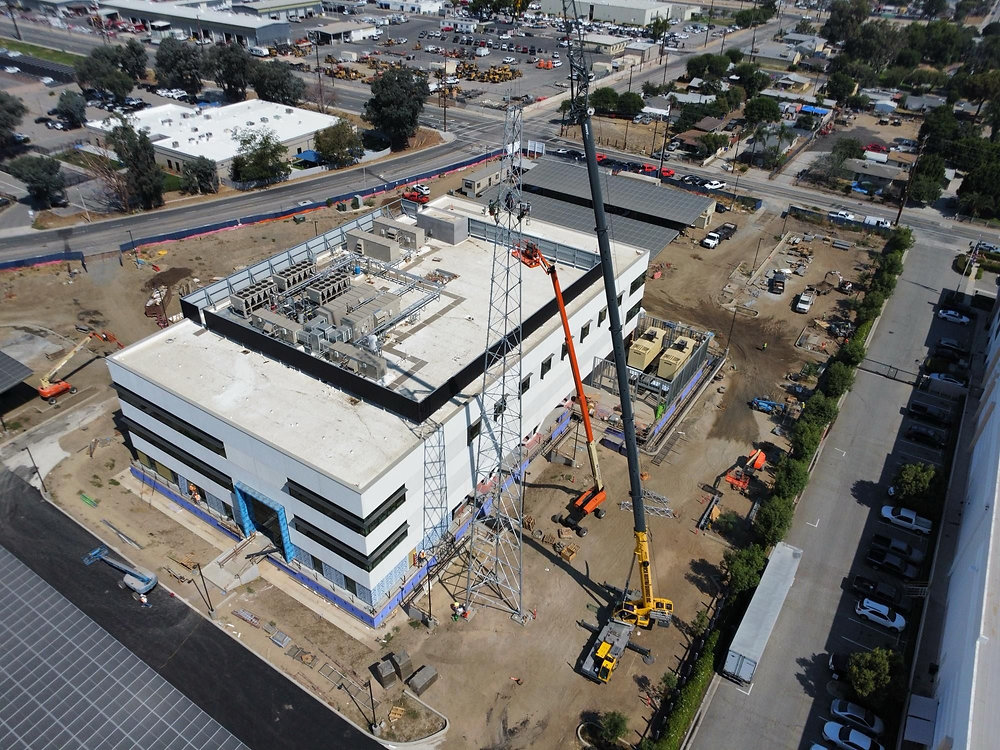
The center is located at the southeast corner of East Rialto Avenue and Lena Road in San Bernardino. Earlier county project descriptions identified the building as a three-story, 75,085-square-foot facility on a 6.85-acre site with a 200-foot communications tower.
The county has described the facility as earthquake-resistant and designed for continuous operations during major emergencies. Earlier project information said the building uses a base-isolation system with 33 isolators and includes backup water, redundant power generation and technology redundancies intended to keep operations going even if outside services are interrupted.
The center was built at a reported cost of $125.6 million. According to the county, funding included $106 million from the federal American Rescue Plan Act, $19 million in county discretionary general funding and about $600,000 from participating agencies, including OES, the Sheriff’s Department and CONFIRE.
What the center is designed to do
The Valley Communications Center is not simply a new dispatch room. It is intended to serve as a central coordination point during emergencies involving multiple agencies and jurisdictions.
County officials said the center includes a modern Emergency Operations Center where county departments, public safety agencies and community partners can coordinate resources during disasters. It also includes a Joint Information Center, which allows public information staff to work alongside emergency operations personnel during major incidents.
That matters in San Bernardino County because of the size and complexity of the operational area. The county covers more than 20,000 square miles, stretching from the urban West Valley to mountain communities, the High Desert, the Colorado River region and large remote desert areas. Incidents can involve city fire departments, county fire resources, sheriff’s units, CAL FIRE, federal wildland agencies, public works, transportation agencies, hospitals, utilities, volunteer organizations and state or federal partners.
County officials also said the existing Emergency Operations Center has been activated nearly 70 times over the past decade for wildfires, winter storms and other emergencies. The new center was designed around lessons learned from those activations.
Agencies involved
The county’s June 2026 announcement specifically identified these operations as part of the new center:
San Bernardino County Office of Emergency Services Emergency Operations Center
San Bernardino County Sheriff’s Department Valley Dispatch Center
Consolidated Fire Agencies dispatch operations
Earlier county project information also listed the Inland Counties Emergency Medical Agency as part of the overall project. The June 2026 ribbon-cutting release emphasized OES, Sheriff’s Valley Dispatch and CONFIRE operations, so the exact current ICEMA role in the facility should be confirmed before describing it as a permanent tenant.
Scanner and radio-monitoring angle
For scanner listeners and public safety monitors, the Valley Communications Center is important because it houses several major emergency communications and coordination functions in a single facility. It may improve how information moves between dispatchers, emergency managers and field responders, especially during large fires, weather events, evacuations and multi-agency incidents.
However, the building itself does not necessarily create new scanner traffic or new publicly monitorable channels. Much of what happens inside a modern dispatch and emergency operations facility takes place on 911 systems, CAD terminals, phones, internal networks, mapping systems, agency data links and other systems that are not available to the public.
San Bernardino County public safety radio monitoring also remains a mixed picture. RadioReference lists the San Bernardino County public safety trunked radio system as a Project 25 Phase I system. It also notes that county fire channels are used in conjunction with the countywide P25 trunked system. CONFIRE dispatch operations extensively use the county P25 system and also simulcast over several VHF repeaters maintained for interoperability.
Law enforcement monitoring is far more limited. Publicly available RadioReference information and user reports indicate San Bernardino County Sheriff operations are encrypted on the county P25 system. That means scanner listeners should not expect to monitor Sheriff dispatch or tactical traffic simply because the new Valley Dispatch Center is operating from a new facility.
What listeners may be able to monitor
Depending on location, equipment and current system programming, listeners may still be able to monitor some fire, EMS, incident and interagency activity associated with San Bernardino County incidents.
Possible monitoring targets include:
San Bernardino County fire and CONFIRE dispatch traffic where it remains in the clear
Countywide P25 fire talkgroups that are not encrypted
VHF fire or interoperability repeaters listed in current frequency databases
CAL FIRE San Bernardino Unit activity during vegetation fires and major incidents
U.S. Forest Service San Bernardino National Forest traffic during wildland fires
Air-to-ground and air tactical channels assigned to wildland fire incidents, when aircraft are working in range
Amateur radio ARES, RACES or local repeater activity during major emergencies, if activated
Broadcastify or Broadcastify Calls feeds where available and legally provided by feed operators
Listeners in the Inland Empire, mountain areas and High Desert should remember that reception depends heavily on location, elevation, antenna quality and which P25 site or conventional repeater is being used. A listener in Hesperia, for example, may hear a very different mix of traffic than a listener in San Bernardino, Rancho Cucamonga, Big Bear or the Colorado River area.
Southern California relevance
The Valley Communications Center is significant beyond San Bernardino County because major emergencies in Southern California rarely remain neatly within a single jurisdiction.
Major wildfires, floods, winter storms, earthquakes, transportation incidents and evacuation operations can involve resources from neighboring counties, CAL FIRE, the U.S. Forest Service, CHP, local police and fire agencies, ambulance providers, public works departments and emergency management offices. San Bernardino County also includes key transportation corridors such as Interstates 10, 15 and 40, mountain resort communities, desert highways, rail lines, logistics centers and aviation facilities.
For radio hobbyists, these incidents can create a wide range of monitorable activity, especially on fire, aviation, public works, amateur radio and interagency channels. The new center may become one of the places where those moving parts are coordinated during the largest incidents.
SCMA takeaway
The opening of the Valley Communications Center is a major public safety infrastructure project for San Bernardino County and the Inland Empire. For the public, the promise is faster coordination and stronger continuity during major emergencies. For scanner listeners, the story is more nuanced.
The best monitoring opportunities will likely continue to be fire, EMS, wildland fire, aviation, interoperability and amateur radio activity, especially during large incidents. Law enforcement monitoring in San Bernardino County remains limited by encryption, and the internal operations of the new center will not be directly monitorable.
Even so, facilities like this shape what listeners hear on the air. When dispatchers, emergency managers and field agencies are working from better systems and sharing information faster, that coordination can show up indirectly in the way incidents are managed, resources are assigned and public information is released.