
Seth Hettena The After-Action Report
Mar 04, 2026
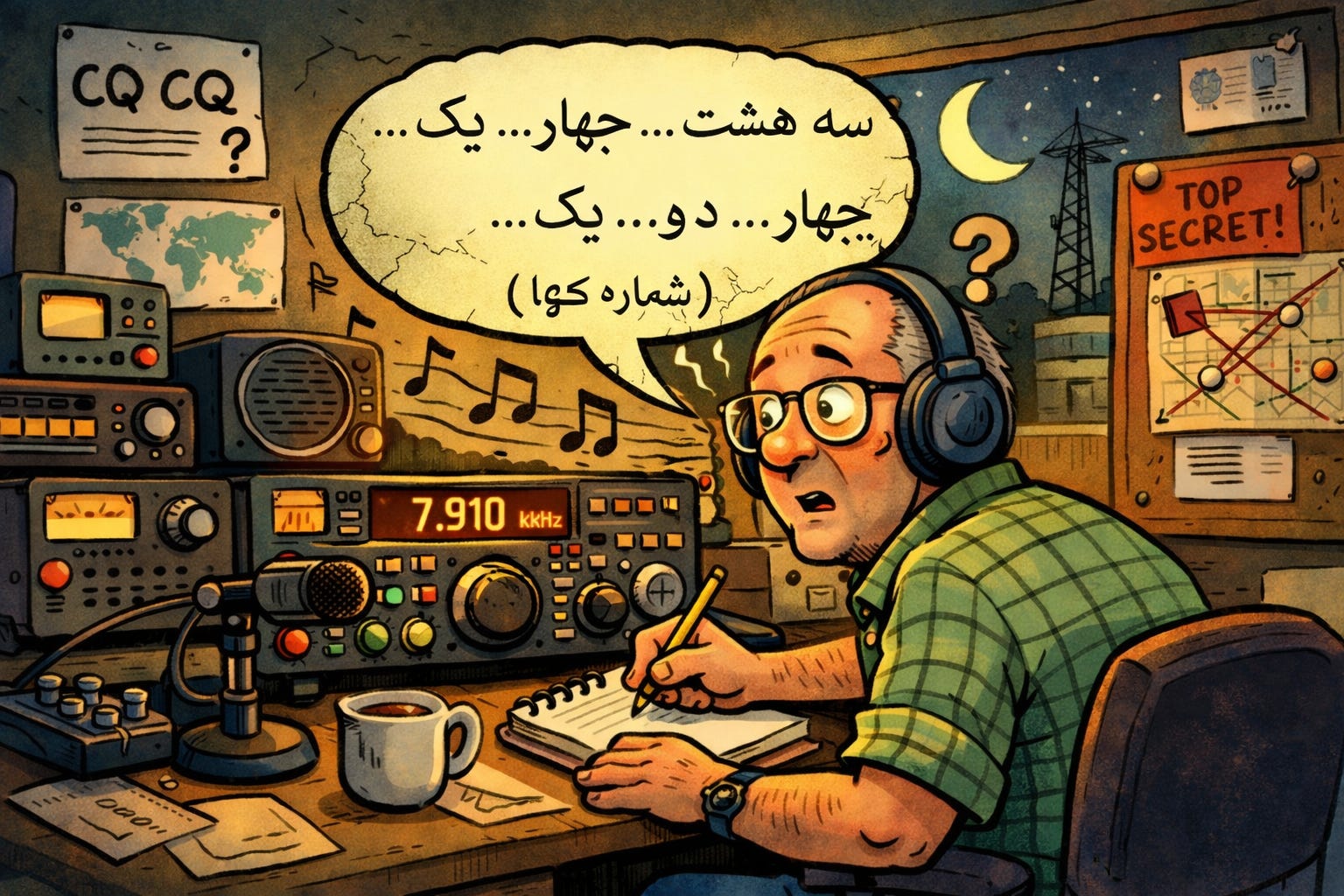
A new shortwave numbers station appeared the day the bombs fell. Nobody knows who’s running it.
A mysterious shortwave radio station began broadcasting strings of numbers in Farsi on the day Israel and the United States first struck Iran. It hasn’t stopped since.
Numbers stations, as they’re known, have been used by intelligence services since World War I to communicate with agents in the field, but have become increasingly rare in the digital age. With the Internet shut down by authorities in Iran, this Cold War relic has found new life. According to one group of aficionados that tracks these age-old spy tools, it’s the first new numbers station in years.
A male voice in Farsi says, “Tavajoh! Tavajoh!” (Attention! Attention!) then reads groups of Persian numbers (like chahâr=4, shesh=6, hasht=8).
The Farsi numbers station, broadcasting at 7910 kHz, was first logged on Feb. 28, the day Israel and the United States first attacked Iran, according to Priyom.org, an international group of radio enthusiasts tracking mysterious stations. It has since been recorded across Europe in early afternoon Eastern time (night in Tehran), although there have been reports of a second transmission.
Who is talking to whom remains the central mystery. Priyom noted that while early reception reports were consistent with a Middle Eastern transmitter, some direction-finding results suggest the signal may originate not from Iran but from somewhere closer to the Red Sea. That raises the possibility that an Israeli, Western, or Arab intelligence service may be broadcasting into Iran rather than out of it.
An Italian ham radio operator, writing under the name Iz0kba Lorenzo, argues for Iranian origin, citing the signal’s strength across Southern and Central Europe, its frequency range—commonly used for military and diplomatic communications in the Middle East—and a voice cadence that experienced monitors say resembles known Iranian utility transmissions. This suggests that Iranian intelligence may be giving orders to agents abroad.
Determining the truth is impossible by design. Both the sender and receiver hold matching one-time pads, identical sheets of random numbers used to encode and decode each message. Once used, the sheet is destroyed. The encryption is considered unbreakable.
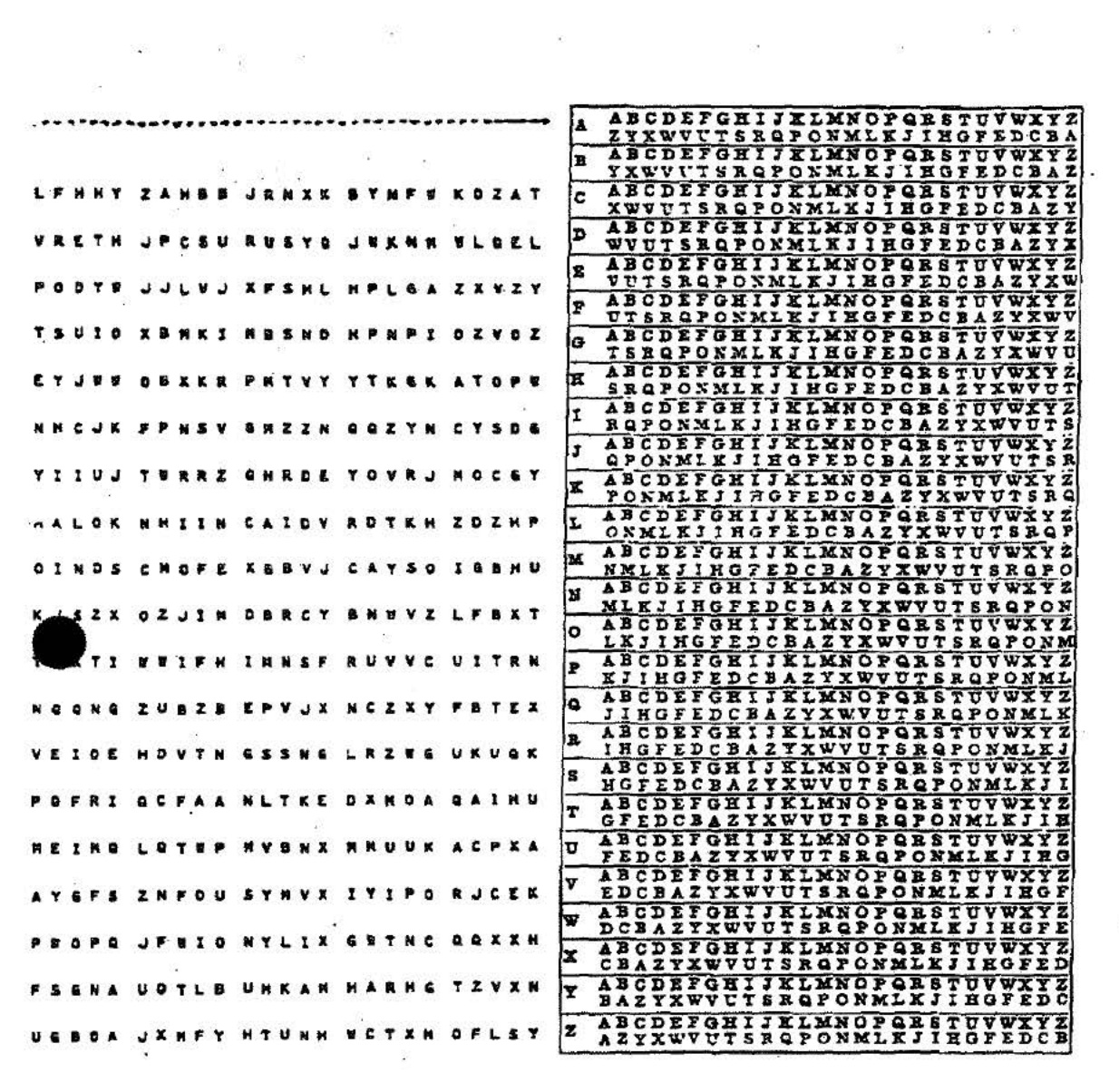
The one-time pad is elegant in its simplicity. Anyone can intercept the transmission, but without the matching key, it’s meaningless. And because the agent never transmits anything back, they can’t be located.
The hobbyist community has not waited for official word. Numbers & Oddities, a long-running archive of clandestine radio signals, has catalogued the station as V32, using the ENIGMA classification scheme that assigns each known numbers station a letter-number designation. (ENIGMA2000, the UK-based group that maintains the official list, has yet to issue a formal bulletin on the signal.)
If confirmed, it would be only the second new voice numbers station to be classified since a Vietnamese station went dark in 2016.
Source: The After-Action Report